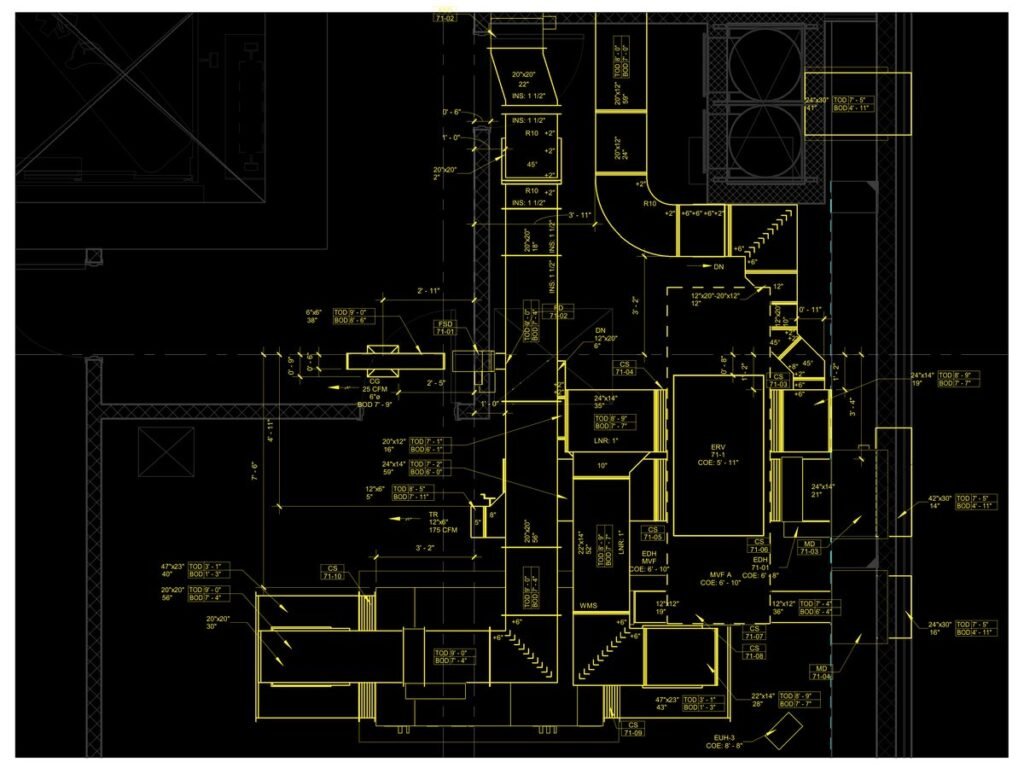
What each document proves
A shop drawing is an instruction to a fabricator. It carries dimensions, cut lengths, gauges, weld locations and piece marks, and it answers one question: what do I build, and to what tolerance.
A coordination drawing is an argument to a general contractor. It shows duct, pipe, plumbing, electrical, fire protection and structure together in the same view, and it answers a different question: does all of this fit in the space we have.
Who actually reads them
This is where the cost hides. A GC asking for coordination drawings will reject a stack of fabrication tickets, because tickets prove nothing about the other trades. A fab shop handed a coordination set cannot build from it, because the dimensions it needs were never on that sheet.
The failure mode on a live job
The set goes out, it comes back marked up, and two weeks disappear from a schedule that had no two weeks to give. Nothing was drawn badly. The wrong document was sent to the wrong reader.
Why both must come off the same model
When the two sets are produced separately, or drawn by hand from different sources, they drift. A late routing change updates one and not the other, and the drift surfaces in the field as a piece that will not go where the coordination set said it would.
Generating both from a single coordinated model removes the possibility. The geometry is the same geometry; only the annotation changes.
What to send, and when
- GC asks for sign-off: coordination drawings, every trade in view, at a scale a person can read.
- Shop asks for tickets: fabrication drawings with piece marks that match the coordinated model.
- Design-assist scope: both, issued together, so the sign-off and the fabrication package cannot diverge.
If you are unsure which one is being asked for, the reliable tell is who is asking. A superintendent wants coordination. A shop foreman wants fabrication.
Sources
- Practice on commercial MEP projects in NJ and the NYC metro.